Let’s be honest: spending your hard-earned money on advertising can feel like a gamble. How can you be sure it will actually bring customers through the door? This small business budget guide is for the busy owner, not the marketing expert.
You likely feel the pressure to be everywhere online, but managing social media can feel like a second job. When it comes to reaching people right in your own town, there is often a more direct path.
This is where newspaper advertising comes in. It remains one of the most effective and affordable local advertising options for a reason. Think about it: a single, well-placed ad can land your message directly on the kitchen tables of hundreds of potential customers in your community.
This guide provides a simple, step-by-step process to set a realistic budget, know what questions to ask the newspaper’s ad representative, and find easy ways to track if your ad is actually making the phone ring.
Are Newspaper Ads Still Worth It? A Quick Comparison for Local Businesses
With everyone talking about online ads, it’s fair to ask if newspapers still have a place. For a local business, the answer is often a surprising yes. While a social media ad might reach people across the state, a newspaper ad targets your neighbors—the people most likely to actually walk through your door this weekend. It’s about reaching the right people, not just more people.
When you talk to a newspaper, you’ll hear two important terms. The first is circulation, which is simply the number of physical copies the paper prints and distributes. Think of it as the number of papers that land on doorsteps and in local shops. It’s a solid starting point for understanding a paper’s size.
However, the number that truly matters to your business is readership. One newspaper is often read by multiple people in a household or a coffee shop. So, if a paper has a circulation of 10,000, its readership might be 25,000 actual readers. This is the total audience you can potentially get in front of.
For a local shop, reaching a focused readership of thousands in your own town can be far more powerful than reaching a scattered online audience of tens of thousands. You’re paying to speak directly to potential customers, not internet wanderers. With a clear understanding of your potential reach, the next step is determining a reasonable budget.
How Much Should You Spend? A Simple Formula to Set Your First Ad Budget
Deciding on a budget can feel like pulling a number out of thin air, but there’s a simple and safe starting point. Most established small businesses dedicate between 3% and 5% of their gross revenue to their entire marketing plan. So, if your business brings in $100,000 in sales per year, your total marketing budget might be $3,000 to $5,000 for the whole year.
Of course, you’re not going to spend all of that on your first newspaper ad. Instead, think small and run a test. Take that annual budget and divide it by 12. Using our example, a $3,000 annual budget becomes just $250 a month. This gives you a manageable, low-risk figure to work with for your first one-month campaign. It’s enough money to make an impact without causing you to lose any sleep.
The most important rule for your first ad is this: only spend what you can afford to lose. Think of it as a small-scale experiment. The goal is to gather information and see what works. If the ad brings in new customers, fantastic! You can confidently invest more next time. If it doesn’t, you’ve learned a valuable lesson for a small price. With a test budget in mind, you can now explore what that money actually buys.
Decoding the Rate Card: What You’re Actually Paying For
When you contact a newspaper, they’ll talk about pricing in a way that can be confusing at first. The key to understanding local newspaper advertising costs is to grasp one simple concept: the column-inch. Think of a newspaper page as a grid. An ad’s size is measured by how many columns it is wide and how many inches it is tall. A small ad might be 2 columns wide by 3 inches tall, making it 6 column-inches. The paper’s “rate card” will tell you the price for each one.
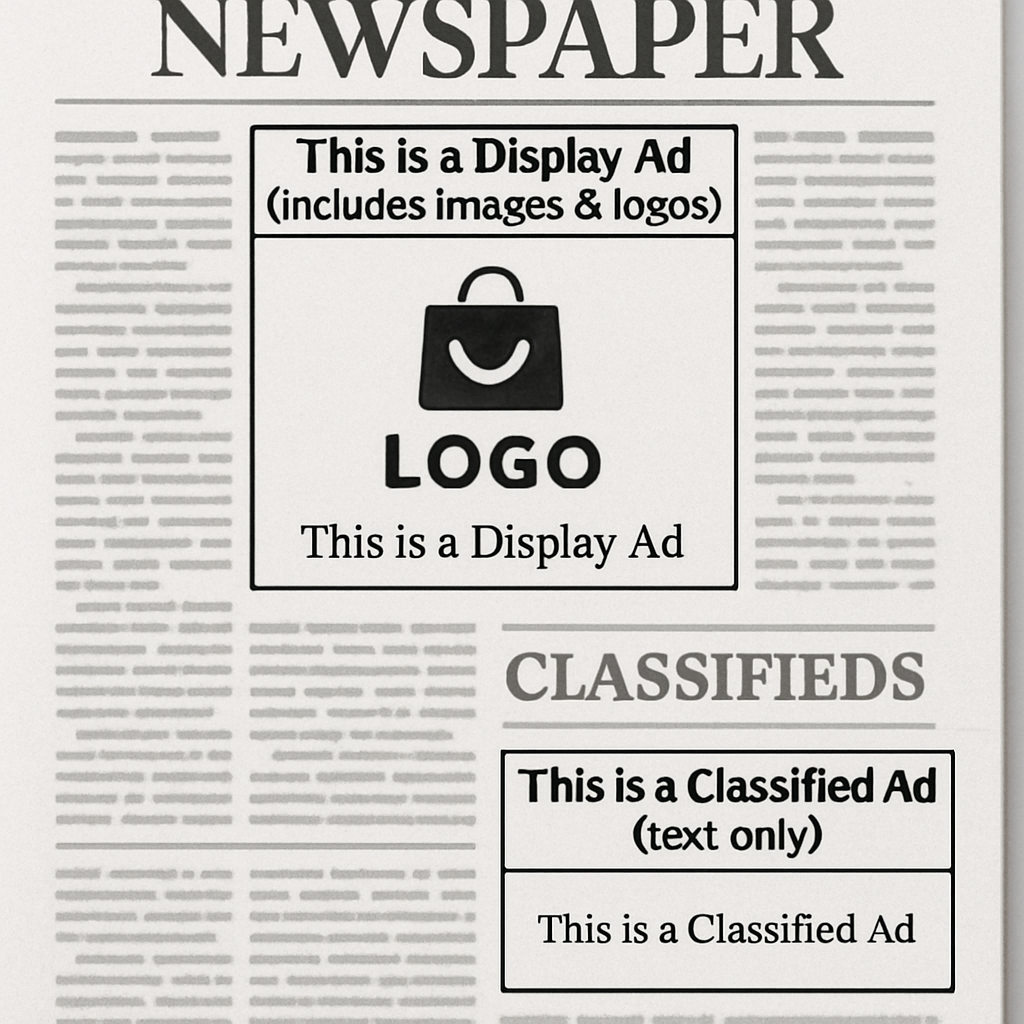
Your next choice is between two main ad types, each with a different purpose. As you can see in the image below, a Display Ad is the classic visual ad with your logo, pictures, and a unique design. It’s perfect for grabbing attention and showing off your brand, like a photo of your bakery’s signature cake. A Classified Ad, on the other hand, is a simple, text-only listing grouped with others in a specific section. Classifieds are cheaper and work well for straightforward announcements, like hiring a new mechanic or promoting a legal service.
To stretch your budget further, you need to know about a powerful tool: the frequency discount. Newspapers reward consistency. Running your ad just once will be the most expensive option. However, if you agree to run that same ad several times—for example, every Friday for a month—the newspaper will often give you a lower price per ad. This not only saves you money but also makes your marketing more effective, as customers will see your message multiple times.
Armed with this knowledge, you’re ready to have a productive conversation with the newspaper’s advertising representative. You now have the vocabulary to move past the sticker price and start talking about real value.
Talking to the Ad Rep: How to Get the Best Deal
Going into a conversation with the newspaper’s ad rep with smart questions shows you’ve done your homework. It shifts the conversation from what an ad costs to what it can achieve for your business and positions you as a savvy partner, not just another buyer.
Instead of just asking “How much is an ad?”, use this checklist to guide your conversation, sound like a pro, and ensure your money is spent reaching the right people.
Your 4 Key Questions:
- What is your total readership in [Your Town/ZIP code]?
- Which section do you recommend for reaching [your target customer, e.g., ‘families with kids’]?
- Do you have any remnant space or package deals for new advertisers?
- What are the deadlines for ad submission?
That third question is your secret weapon. Remnant space is unsold ad space that papers sell at a deep discount to avoid printing an empty spot—think of it like a last-minute deal on a hotel room. A package deal bundles multiple ads together for a lower price, much like a combo meal at a restaurant. Both are excellent ways to stretch a small budget.
The 3 Elements of a Newspaper Ad That Gets Calls
Once you’ve secured your ad space, you need to make every square inch count. The most effective ads follow a simple but powerful A-B-C formula. A bold headline is your most important tool, and its only job is to grab Attention. Instead of just your business name, lead with a benefit that solves a problem. “Tired of Yard Work?” is far more effective than “Joe’s Landscaping Services” because it hooks the reader instantly.
After grabbing their attention, you must immediately offer a clear Benefit. People scan newspapers for value, so one irresistible offer is more powerful than a long list of services. For example, a pizzeria ad with a bold “Free Garlic Knots with Any Large Pizza” will get more calls than one listing the entire menu. This gives readers a direct and compelling reason to act.
Finally, you must tell them exactly what to do next with a strong Call to Action. Never assume customers will figure it out—be explicit. Use clear, urgent phrases like “Call today to book your spot” or “Bring in this ad for 15% off.” These simple instructions are crucial for turning a reader into a paying customer.
This A-B-C formula—Attention, Benefit, and Call to Action—is the recipe for an ad that gets results. That special offer in your call to action does double duty, too. It’s not just an incentive; it’s also the secret to easily measuring your ad’s return on investment.
How to Know If It Worked: Tracking Your Ad’s Success Without Fancy Software
That special offer you included in your call to action does more than just bring people through the door. It’s your secret weapon for figuring out if your ad was a good investment. This simple tracking method turns advertising from a risk into a calculated decision, giving you a clear answer to the question: “Did I make more than I spent?”
The easiest tracking system uses a unique offer for that specific ad. A line like, “Bring in this coupon for a free doughnut” or “Mention this ad for 10% off” acts as a homing beacon. For a retail shop or a restaurant, this provides a physical stack of coupons you can count. Each time a customer uses that specific deal, you know with certainty that they came directly from your newspaper ad.
For service-based businesses, a similar approach works for tracking phone calls. Just train yourself and your staff to ask every new caller, “And how did you hear about us?” Keep a simple tally sheet by the phone. At the end of the campaign, you can do some simple math. If your ad cost $300 and the new customers it brought in generated $500 in profit, you know it was a success.
But what if the math doesn’t work out the first time? Don’t panic. That isn’t a failure; it’s valuable feedback. Maybe the offer wasn’t strong enough, or the ad ran on the wrong day. You now have real-world data to make your next attempt even better.
Your 5-Step Action Plan to Launch Your First Newspaper Ad
Just a short while ago, the thought of creating a newspaper advertising budget might have felt like a shot in the dark. You’re no longer guessing. You now have a clear, low-risk roadmap that turns a confusing marketing task into a simple, manageable experiment for your business.
Here is your exact plan of attack.
Your First Ad Campaign Checklist
- Set a Small Test Budget (e.g., $400, based on 3-5% of revenue).
- Call your local paper and ask the ‘4 Key Questions’.
- Design a simple ad with ONE clear offer (e.g., “15% off this week”).
- Run the ad for a set period (e.g., every Friday for one month).
- Track your results (e.g., count the coupons).
This checklist transforms a newspaper ad from an unknown expense into a measurable tool for attracting local customers. You don’t need to become a marketing expert overnight; you just need to take one small, smart step to bring more people through your door.
Your first step? Pick up the phone and call your local paper.
Explore Our Marketing Services
Businesses looking for a results-driven ad agency in Bangladesh can rely on Media BD Agency for complete growth solutions.
Our team offers digital growth services designed to improve traffic, leads, and conversions.
We also provide social media marketing solutions to help brands stay active and engaging online.
With expert Facebook marketing services, you can reach highly targeted audiences.
Additionally, our media publishing services help build trust through credible exposure.