Imagine you have a new online clothing page. Before Eid, you have a budget of 5,000 BDT for your first ad campaign. Should you spend this money on Facebook showcasing photos of your new sari designs, or should you show your ad on Google when someone searches for ‘saris for Eid’? This single decision could determine your business’s profit or loss.
For most new entrepreneurs, this is a common dilemma, coupled with the fear of wasting money. Facebook and Google are both powerful platforms, but it’s hard to know where to spend your hard-earned money for the best return. Choosing the wrong platform doesn’t just mean losing money; it also means losing valuable customers, which is a significant blow for a small business.
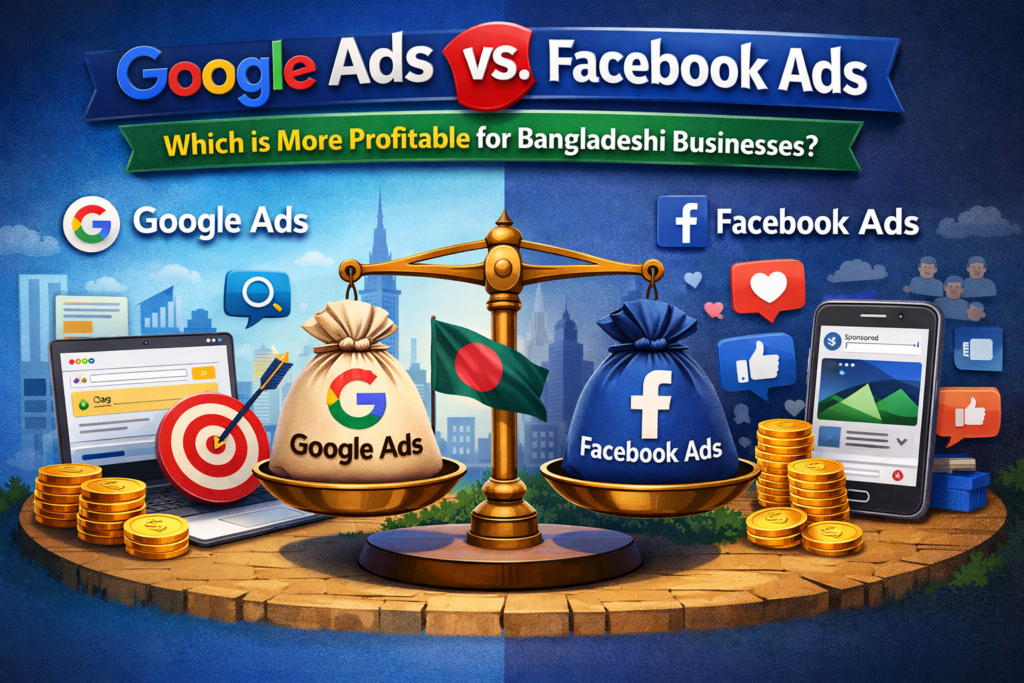
The way these two platforms work is fundamentally different. Think of Google as a hardware store; people go there when they need something specific and are actively looking for it. On the other hand, Facebook is like a fair; people come to spend time with friends and might suddenly become interested in buying your beautiful product upon seeing it. The best choice for your business is hidden within this core difference.
This article will clarify the Google Ads vs. Facebook Ads debate for Bangladeshi businesses, helping you find a clear answer for yourself and confidently take the first step in your advertising journey.
Google vs. Facebook: A Hardware Store or a Fair?
The easiest way to understand Google and Facebook advertising is to imagine two different scenarios. Imagine Google is a hardware store. People go there only when they need something specific—like a hammer or a screwdriver. They enter the store already knowing what they want to buy. Google Ads works just like this. When a customer urgently needs something (e.g., “best biryani in Dhaka” or “AC mechanic nearby”), they search on Google. If your ad appears right at that moment, you get an interested customer. This is called Search Intent.
On the other hand, Facebook is like a bustling fair. People are there to chat with friends, look at photos, or just pass the time. They don’t come with the specific intention to buy anything. But while strolling through this fair, they might suddenly spot your stall with beautifully designed clothes, and an urge to buy is created. This is precisely what Facebook Ads does. As people scroll through their newsfeed, your attractive product ad creates a new interest (Social Discovery). They might not have needed the item at that moment, but seeing the ad made them want to buy it.
This fundamental difference determines everything for your business. Do you want to reach customers who are already searching for your product or service (Google)? Or do you want to create new demand or interest for your product among people who may not even know about your business yet (Facebook)? The success of your advertising depends on the correct answer to this question.

When Customers Are Looking for You: Who is Google Ads For and Why is it Best?
Remember the hardware store analogy? Google Ads operates in that exact space. When a customer searches on Google with a specific need, the main job of Google Ads is to put your business in front of them. The biggest advantage of Google Ads is that you are getting a customer who is already mentally prepared to buy your product or service. You don’t need to convince them, because they found you themselves.
The entire process works through a magic word called a ‘Keyword’. A keyword is the word or phrase people type into Google to search. For example: “good Chinese restaurant in Mirpur” or “emergency plumber service.” With Google Ads, you can tell Google to show your ad whenever someone searches for these types of keywords. This is the easiest and most effective way to target customers with Google Ads. The foundation of successful Search Engine Marketing (SEM) in Bangladesh is choosing the right keywords.
So, for whom is Google Ads most essential? It’s indispensable for any emergency service or specific product-based business. Think about it: if someone’s home geyser breaks or they have a severe toothache, will they browse Facebook? No, they will immediately search Google for “geyser repair near me” or “best dentist in Dhaka.” If you have this type of business, Google Ads will connect you directly with that hot lead who is ready to spend money right now.
When You Are Creating New Customers: Who is Facebook Ads For and Why is it Best?
Facebook is the complete opposite of Google’s hardware store. Think of Facebook as a fair where people come to hang out with friends. They aren’t there with the intention to buy anything specific. But suddenly, your ad for an attractive dress or delicious food catches their eye and creates a desire to purchase. This act of creating interest before someone even searches for something is the core strength of advertising on Facebook. This is how Facebook Ads work—it generates new demand.
This method is incredibly effective for businesses whose products are visually appealing and don’t require much thought before a purchase decision. Examples include clothing businesses, cosmetics, new restaurants, cake shops, or handmade gifts. A person might not actively search on Google for a “new design Panjabi,” but seeing a picture of your Panjabi on Facebook might make them want to buy it. That’s why Facebook is an almost essential platform for digital marketing for e-commerce businesses.
Besides direct sales, another major advantage of Facebook is building Brand Awareness, which means making your business name known to many people. You can reach thousands of potential customers with your ad at a relatively low cost. In the Facebook Boosting vs. Google Ads debate, Facebook is far ahead when it comes to building brand recognition on a small budget.
The Cost Breakdown: How Much Does It Cost to Advertise on Each Platform?
When it comes to advertising, the first question that comes to mind is, “Which one is cheaper?” But a more important question is, “Which one will be more profitable for my business?” The way you spend money on Google and Facebook is slightly different, and understanding this will help you plan your digital marketing budget better. Both platforms operate within your set budget, but they charge in two main, distinct ways.
These two cost models can be thought of simply:
- Google Ads: You generally pay-per-click (PPC). This means even if thousands of people see your ad, you won’t be charged. Money is only spent when someone is interested enough to click on your ad and visit your website.
- Facebook Ads: The cost is primarily impression-based, meaning it’s based on how many people saw your ad or how many times it was shown. You pay to get your ad in front of many people, whether they click on it or not.
Now, you might think paying for clicks is better. But it’s not that simple. Let’s say you have an AC repair business. A click from someone who searched “AC repair near me” on Google might cost you 50 BDT. On the other hand, for just 50 BDT on Facebook, you might be able to show your ad to 1,000 people. Here, the online advertising cost in Bangladesh isn’t about which is higher or lower. The key is that the single customer from Google is much more likely to convert because they need the service immediately.
This doesn’t mean one is better than the other. Both are powerful if you know when to use them. If you have a small budget, you can run small tests on both platforms to see which works better for you.
Which is Best for Your Business? A Simple Decision Guide
By now, you understand the core differences and cost structures of Google and Facebook. The most important question remains—which is better for your business? Let’s arrive at a simple decision based on your business type, so you can choose the best advertising for your small business.
If you have a service-based business—for instance, you’re an electrician, plumber, doctor, or you have an AC repair shop—then Google Ads is almost always the best choice. This is because when people need these services, they don’t scroll through friends’ photos on Facebook; they go straight to Google and search. If your ad appears before them at that moment, your chances of getting the job increase significantly.
On the other hand, if you have a product-based business, such as an online clothing page, home decor items, a new food product, or gadgets, then Facebook might be your first choice. People may not be looking for your product right now, but while scrolling through Facebook, an attractive picture or video of your product might entice them to buy. Facebook is a master at creating new demand in people’s minds.
However, for some businesses, both platforms are equally important, which is a great strategy for marketing for local businesses in Bangladesh. For example, if you have a restaurant or cafe. Someone might find your establishment by searching for “good restaurants nearby” on Google. Alternatively, someone might see a tempting photo of your food on Facebook and decide to visit with friends. By advertising on both platforms, you can capture all types of customers.
What Should Your Ad Budget Be, and How Do You Know if It’s Successful?
Many people think online advertising requires a lot of money, which is a major concern for small businesses. But the truth is, you don’t have to spend thousands of Taka right from the start. With a small budget of just 1,000 to 2,000 BDT, you can test ads on both Facebook and Google. This small digital marketing budget plan will help you understand which type of ad works best for you without taking a big risk.
To determine if an ad is successful, don’t get distracted by the number of likes, comments, or shares. The real success of your business is sales or customer inquiries. Therefore, you should count the total number of messages you received on your Facebook page or how many phone calls your shop received from the ad. If your restaurant ad resulted in two phone calls for table bookings instead of 10 likes, that is true success.
Calculating the profit or loss from advertising is also quite simple. Suppose you spent 1,000 BDT on ads. As a result, you received some messages on your page and sold products worth a total of 5,000 BDT. If your total profit from these sales is 2,000 BDT, it means you earned 2,000 BDT by spending 1,000 BDT. This simple ad ROI calculation is enough to understand its effectiveness. As long as your profit is greater than your cost, your ad is on the right track.
This calculation is easy for Facebook since customers message your page directly. But what about Google Ads? Many believe a costly website is mandatory, which is a big hurdle for new entrepreneurs. So, the question arises: is it possible to run Google Ads without a website?
Is It Possible to Run Google Ads Without a Website? Yes, in a Few Ways
Yes, it’s possible to get customers directly from Google Ads without a website, and it’s much easier than you might think. Google has a special type of ad called ‘Call-only Ads’. Let’s say you have a plumbing or electrician service. When someone needs urgent help at home, they will search on Google. When they see your ad, they can call you directly by clicking a button on the ad, without visiting any website. This is a powerful answer to the question, what are the benefits of Google Ads—it connects you directly with a customer in their moment of need.
Another highly effective method is to use your Google Business Profile. This is a free tool from Google that displays your business as a digital storefront on Google Maps. If you have a small restaurant or a tailor shop in Dhanmondi, this profile is essential for you. When setting up your ad, you can use the link to this profile as your website. As a result, when someone searches for a service near your area, they will see your ad with your shop’s address, opening hours, and phone number, which greatly simplifies marketing for local businesses in Bangladesh.
Some people consider using their Facebook page link in Google Ads. While this is possible, it doesn’t always yield good results. A user searching on Google wants information or a solution quickly. If they are sent to a Facebook page that is slow to load or where information is hard to find, they lose interest. Therefore, if you don’t have a website, using Call-only Ads or a Google Business Profile to get direct phone calls is the best advertising strategy for small businesses.
So, What’s Your Next Step? Decide Today.
You no longer see Google or Facebook Ads as you did before. Where there were once just two familiar names, you now see two different kinds of storefronts—one is like a fair (Facebook), where you create interest, and the other is like a hardware store (Google), where people come looking for things they need. Understanding this difference is your first major victory.
So, what is your first step? Don’t overthink a large digital marketing budget plan. Just take a small budget of 1,000 or 2,000 BDT and run a test ad on the platform that seems most logical for your business. Your goal isn’t to boost sales overnight, but to see for yourself how this system works. This small step will increase your confidence manifold.
Ultimately, the answer to the “Google Ads vs. Facebook Ads for Bangladeshi businesses” question lies with you. Ask yourself today: Are my customers actively looking for me (then Google), or do I need to find them and make them interested in my product (then Facebook)? Whatever the answer, you are now fully prepared to set aside your hesitation and run your first ad.